Told rockets couldn't land themselves, he proved experts wrong. Again
““It was just me and a man named Elon. Not long after that life-changing meeting, I submitted my retirement papers from the U.S. Air Force, and I was fortunate to be selected as site director of SpaceX’s Vandenberg launch site.””
By JOS Editorial
published November 2, 2026updated November 4, 2026
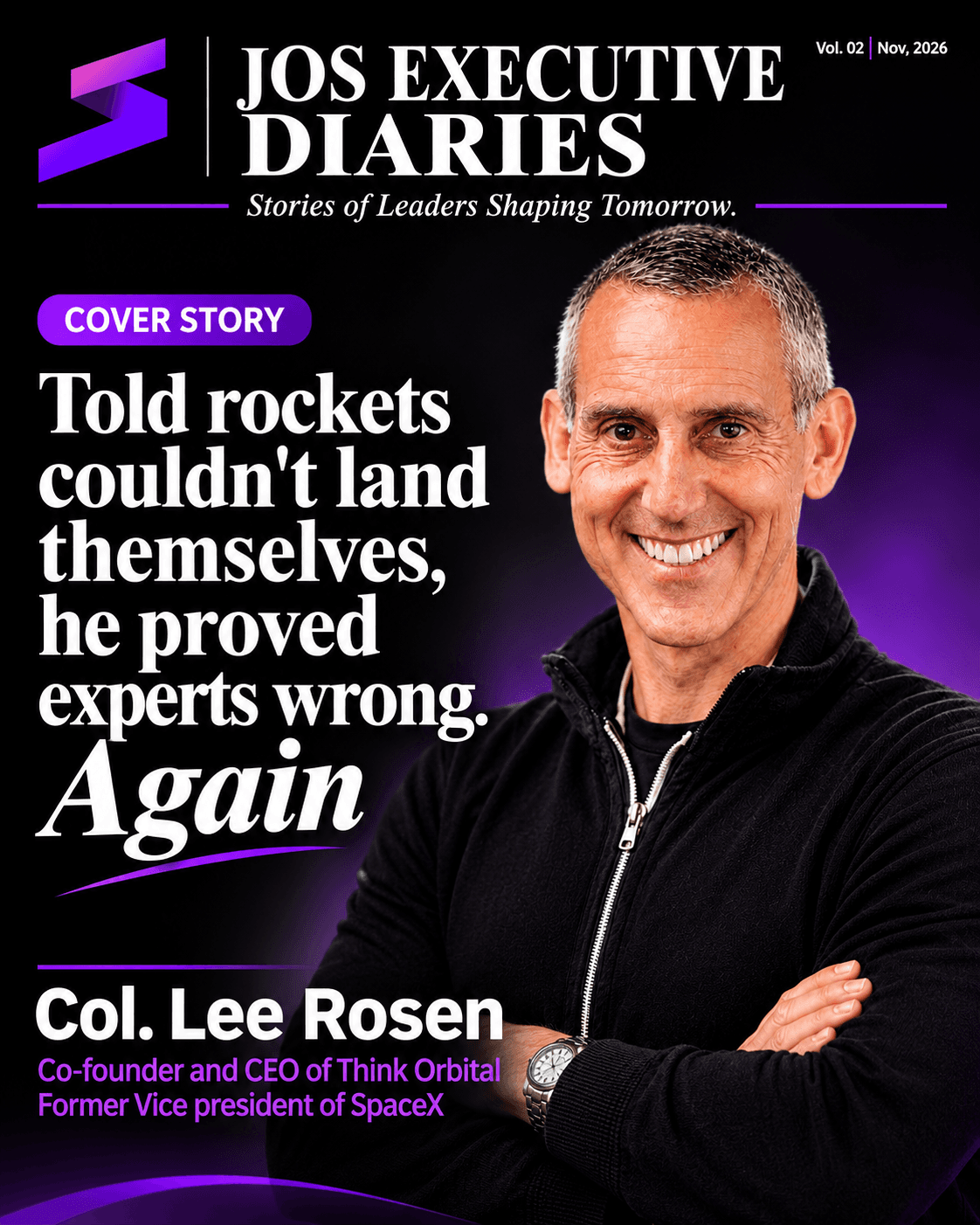
co-founder and CEO of Think orbiter and also you were previously the vice president of SpaceX mission and operation launch system
“From Titan Pads to Falcon 9: Why Space’s Next Constraint Is Size”
“My journey began in childhood, with a fascination for mechanical things. I was the kid who took apart my parents' lawn mower and tried to put it back together. Like my father, who served in the US Army Air Corps, I wanted to serve in the Air Force and become a pilot. I attended the US Air Force Academy in Colorado Springs, majored in engineering, and went on to a 23-year Air Force career as an engineer, acquisition officer, and space operator. Along the way, I held multiple assignments at Space Systems Command, where the Space Force buys all its space hardware, and at the National Reconnaissance Office, which buys and flies the nation's spy satellites. I also commanded at both launch bases, Vandenberg and Cape Canaveral.
While I was at Cape Canaveral, my four-star general boss called to say that President Obama was coming to the Cape to announce a commercial space initiative: cargo and humans would be launched to the International Space Station on commercial vehicles.
During that time, Elon kept quizzing me about what happens to a rocket after launch. "It goes in the ocean," I said, "and that's it." He asked if I knew any other mode of transportation that's thrown away after one use. I couldn't think of one. Then he asked how I would land a rocket. I asked if he meant like the space shuttle. "No, no, no. Very different." I suggested aerosurfaces, parachutes, any number of options. He dismissed them: too heavy, and parachutes won't work on Mars. I remember thinking, "This guy is a little bit crazy, but he has something here."
At the time, the US had pretty much offshored its commercial launch capability to Russia and France.”
“I was selected as site director for SpaceX's Vandenberg launch site, tasked with taking down a Titan 4 and a Titan 2 launch pad. I had worked on both as a young captain in the US Air Force, so it was a monumental job. With Elon closely involved, we converted the pad from Titan 4 to Falcon 9 and Falcon Heavy in about 18 months, quickly and for relatively little money. I was there for the first Falcon 9 launch and a couple more after it.
Elon then asked me to run launch operations for the company. For several years we integrated military, commercial, and civil payloads onto Falcon 9 and Falcon Heavy and flew the Dragon spacecraft, cargo and crew versions alike. It was an incredible opportunity.
Still, I had an entrepreneurial itch. At SpaceX we often discussed the constraints of space, and I think we largely solved the first: getting there. Launch is now reliable, affordable, and high-cadence. My biggest year was 30 launches; this year the team will hit close to 200, going even better and faster than we did.
This call is even coming to you over Starlink, which delivers data almost anywhere on the planet for around $100 a month. That constraint is essentially gone. The next big one, in my view, is size. Everything in space is tiny compared to terrestrial applications. You wouldn't build a factory on Earth 30 meters long and five meters wide, because you couldn't scale, and scale is exactly what space lacks. The International Space Station, our largest structure, is only about a thousand cubic meters. So we came up with a great idea.”